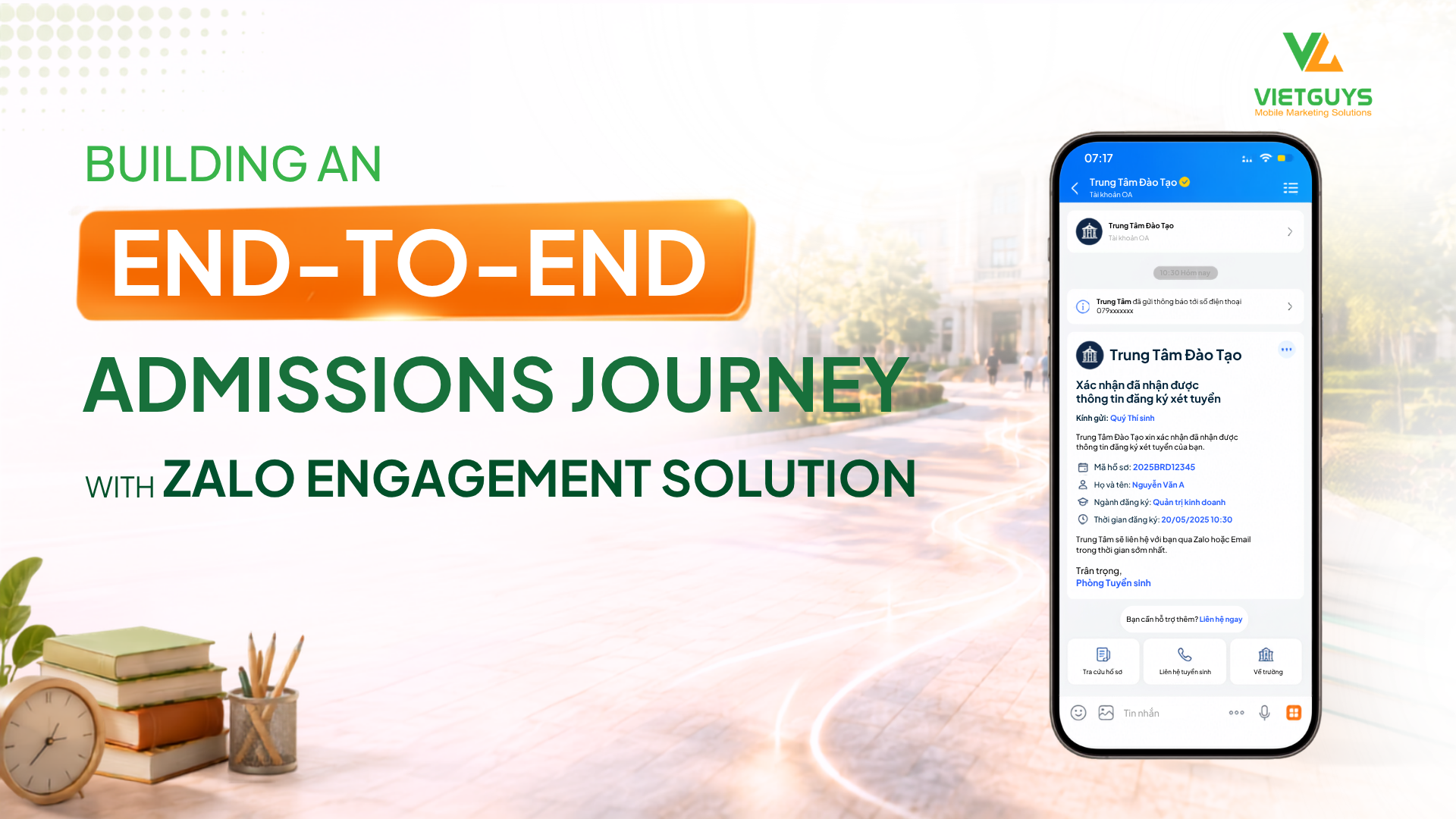
In admissions, acquiring new leads is only the first step. From the moment prospective students submit their information until they officially enroll, they navigate multiple stages—including consultation, application completion, entrance testing, tuition payment, and enrollment preparation. Missing a single touchpoint can disrupt the entire conversion process.
As lead volume grows, manually maintaining engagement and tracking each student's status becomes increasingly difficult to execute with timeliness and consistency. The core challenge is no longer just how to generate more leads, but how to maintain continuous connection and drive prospective students through every stage of the journey.
To address this challenge, educational institutions need a communication channel that enables continuous engagement while seamlessly fitting into students' daily habits. Zalo is one of the most widely used communication platforms in Vietnam, boasting 80.2 million monthly active users and approximately 2.1 billion messages sent daily as of Q1/2026. This massive reach enables educational providers to build continuous touchpoints with prospective students on a familiar platform—from initial confirmation to application reminders, entrance tests, payments, and onboarding.
To make these touchpoints truly drive conversions, educational institutions must view admissions as a continuous end-to-end journey rather than fragmented, standalone activities.
What is an End-to-End Admission Journey, and What Are Its Key Stages?
An end-to-end admission journey encompasses the complete lifecycle of a student—from their initial interest in an educational program and submitting lead information, through consultation, administrative procedures, and official enrollment, to post-enrollment engagement.
This journey consists of 7 key stages: Lead Capture, Consultation, Application Completion, Assessment / Entrance Testing, Tuition Payment, Onboarding Preparation, and Post-Enrollment Engagement. Each stage has its own conversion goals, potential drop-off points, and specific KPIs.
Rather than relying solely on total leads and final conversion rates, institutions can pinpoint exactly where prospective students drop off, identify the underlying reasons, and deploy targeted interventions at specific friction points to boost conversion rates.
1. Lead Capture: Response Speed Dictates Lead Activation
New leads should be acknowledged immediately upon form submission, and follow-ups by the admissions team should occur within 1 hour. According to a Harvard Business Review study analyzing over 2.24 million leads, companies that respond within this timeframe are nearly 7 times more likely to qualify the lead compared to those waiting an extra hour, and over 60 times more likely than those responding after 24 hours.
At this stage, the main challenge lies not in lead volume, but in real-time processing capability. When prospective students receive no immediate acknowledgment or guidance on next steps, their interest wanes before the consultation even begins. This friction point is often overlooked if institutions only track raw lead volume, as leads remain in the system but are never effectively activated.
To maintain rapid response times as lead volume scales, a two-tier approach is essential: automated systems immediately trigger confirmation notifications upon lead creation, while the admissions team handles in-depth consultations over the following 24 hours. Operating this workflow requires logging complete lead metadata—such as source, intent, and timestamp—to ensure smooth assignment and tracking.
2. Consultation: Tracking Decision-Making Leads and Preventing Leakage
Once a lead is captured, the admissions team must provide comprehensive details—course content, tuition fees, intake schedules, prerequisites, and registration workflows—to help students evaluate the program.
Friction typically arises when students need time to consider options or are not ready to register immediately. Without a proper tracking mechanism, these prospective students are easily neglected as teams focus on incoming leads.
The effective management approach is assigning specific statuses to each lead and configuring automated follow-up triggers at 48 to 72 hours if no response is received. Additionally, lead databases should categorize records into four distinct segments: Contacted & Considering, Unreachable, Converted, and Declined. Each group requires a dedicated nurturing workflow to avoid spamming converted leads or abandoning prospective ones.
3. Application Completion: Status-Based Application Recovery
Incomplete applications should be identified by specific field-level statuses rather than binary "submitted" or "unsubmitted" tags. For pending applications, automated reminders can be scheduled at 24-hour and 72-hour intervals after initial creation.
After deciding to register, students often need to submit additional documents or details. Applications are rarely completed in a single session—students may stall due to missing documents, unclear requirements, or simple interruptions.
Consequently, reminder effectiveness heavily relies on specificity. Notifications explicitly stating missing documents and providing direct action links outperform generic reminders. This capability requires real-time application updates at the granular field level.
4. Entrance Testing: Managing Registration and Attendance Rates
Attendance drop-off can be mitigated by issuing test reminders at two key intervals: 24 hours prior (allowing students to adjust schedules) and 1 hour prior (prompting immediate action). Every notification should include clear instructions on test formats and access locations.
For programs requiring entrance assessments, students must complete this verification before qualifying for admission. Even after registering for a test, drop-offs occur due to forgotten schedules, unclear procedures, or lack of preparation—especially for online tests where technical confusion can prevent attendance.
Systems must track both registration status and actual attendance rates. Unattended registrants represent high-intent leads who have already demonstrated clear commitment; prioritizing this group with alternative testing slots helps retain them in the pipeline.
5. Tuition Payment: Accelerating the Path from Qualification to Payment
As soon as a candidate qualifies, detailed tuition information should be dispatched—including total fee amounts, deadlines, payment methods, and transaction statuses. Automated reminders can be scheduled 3 to 7 days before the deadline depending on program timelines. This interval maintains engagement and assists students in completing payments without feeling pressured.
This step is a critical conversion milestone involving a financial transaction. Any ambiguity or friction in the payment process delays the transition from qualified lead to enrolled student.
Institutions should track the average time elapsed between qualification and payment completion. This metric measures the overall efficiency of pre-payment interactions. Abnormally long delays usually point to friction in counseling, fee transparency, or payment processing rather than the transaction step itself.
6. Onboarding Preparation: Preventing Post-Conversion Drop-off
Payment completion does not eliminate drop-off risk; students still require essential onboarding details to prepare for class. Key details include start date and time, class schedule, location or online room link, and required preparation materials.
If onboarding details are incomplete or missed, the transition from paid applicant to active attendee can stall—wasting the acquisition and conversion costs already invested.
Onboarding preparation should be managed as a distinct phase with dedicated KPIs. The ratio of actual attendees to paid applicants serves as a vital metric for measuring the gap between recognized revenue and active course participants.
7. Post-Enrollment: Sustaining Engagement for Future Lifecycles
Once payment is completed, students must still be provided with all necessary details to ensure they are fully prepared to begin their studies. At a minimum, this includes four key pieces of information: start date and time, class schedule, physical location or virtual classroom link, and required preparation for the first session.
If post-enrollment communication is incomplete or messages are missed, the transition from payment to actual participation can easily fall through. This is a critical friction point to address, as the institution has already incurred the bulk of its acquisition and conversion costs.
Therefore, post-enrollment onboarding should be managed as a distinct phase with its own dedicated KPIs, rather than assuming the journey ends at payment. The ratio of actual attendees to paid students serves as a key metric for identifying the gap between recognized revenue and active learner engagement.
.png)
"Leads are just the starting point; true conversion happens across the entire admissions journey."
Source: VietGuys
How Zalo Engagement Solutions Automate the Admission Journey
Zalo Engagement Solutions is an enterprise interaction suite built on the Zalo platform, comprising four key pillars: Campaign Operations Tools (Messaging, Voucher, Reward), Automation System & Zalo Gateway, Zalo Mini App, and AI Engagement.
Within the admissions framework, these four components handle student acquisition, status-driven interaction flows, centralized registration experiences, and automated FAQ handling. To manage the end-to-end journey, educational providers need an integrated ecosystem capable of unifying data, automating workflows, and delivering personalized touchpoints at every stage.
1. Campaign Operations Tools
This suite enables institutions to execute Messaging, Voucher, and Reward campaigns on Zalo—ideal for attracting, activating, or driving immediate decisions from prospective students during peak enrollment seasons or course launches.
Example: When launching a new program, an institution can deploy targeted Messaging campaigns to interested student segments, offering early-bird tuition vouchers for prompt registrations. Captured lead data can then automatically feed into downstream consultation workflows.
2. Automation System & Zalo Gateway
This component integrates admissions CRM/database systems with Zalo, automating messaging workflows based on real-time lead status triggers instead of manual list management.
Example: When a lead submits an inquiry form, the system triggers an instant confirmation message. If the application remains incomplete, a follow-up reminder is automatically scheduled. Once submitted and scheduled for an entrance test, the system sends automated exam details and payment reminders upon qualification.
3. Zalo Mini App
Zalo Mini Apps create a lightweight, embedded application experience directly within Zalo, enabling students to search for courses, check schedules, view tuition structures, and submit applications without leaving the app.
Post-enrollment, Mini Apps transition into student portals for checking class schedules, accessing study materials, or registering for advanced courses.
4. AI Engagement
AI Engagement enhances student interactions through conversational AI and contextual reasoning. Rather than relying on rigid canned responses, AI answers specific inquiries regarding tuition, schedules, and admission prerequisites in real time.
For complex queries outside the AI's scope, conversations seamlessly escalate to human counselors—enabling institutions to scale response capacity while maintaining personalized service.
Integrating these four components transforms Zalo from a basic notification tool into a continuous interaction layer across the entire student lifecycle.
Case Study: FAHASA Achieves +126.7% Orders per Customer with "Buy To Play"
The "Buy To Play" campaign—co-developed by FAHASA and VietGuys during the Online Book Fair—demonstrates the power of Zalo Engagement Solutions in driving user interaction and sales conversion. To incentivize repeat purchases, FAHASA combined Zalo Mini Apps, Gamification, Messaging, and Rewards into a unified user flow.
Key Results:
- +126.7% increase in orders per customer.
- 18,722 game plays generated.
- 2,098+ new Official Account (OA) followers gained.
This campaign highlights how multi-tool integration on Zalo accelerates sales actions while building a qualified database for post-campaign re-engagement.

Frequently Asked Questions (FAQ)
Is Zalo Engagement Solution suitable for educational institutions?
Yes. Zalo Engagement Solutions can be customized to match the unique admission journeys of universities, K-12 schools, language centers, and vocational institutions based on their operational workflows.
Which stages of the admission lifecycle can the solution support?
The solution supports the entire journey: Lead Capture, Course Consultation, Application Completion, Entrance Testing, Tuition Payment, Onboarding, and Post-Enrollment Engagement.
Can content be personalized for different student segments?
Yes. Automated workflows deliver tailored content based on real-time student actions and statuses—ensuring new leads receive different messaging than candidates awaiting payment or test results.
Which key performance metrics should institutions measure?
Beyond raw lead volume, institutions should monitor 6 core metrics:Lead contact rate within 24 hours, stage-to-stage conversion rate, application completion rate, entrance test attendance rate, qualified-to-payment conversion rate, paid-to-enrolled attendance rate
These KPIs help pinpoint exact drop-off points within the funnel.
Conclusion
An effective admissions strategy is measured not merely by lead volume, but by how many prospective students successfully transition through every stage to final enrollment.
By delivering timely, contextualized touchpoints, institutions can minimize drop-offs and maintain meaningful engagement throughout the funnel. Zalo Engagement Solutions provides the infrastructure needed to shift from simple lead management to a fully automated, end-to-end admission journey that maximizes conversion rates and student lifetime value.
Contact VietGuys right here for consultation on Zalo Engagement Solutions, connecting data and automating touchpoints throughout the admissions journey to help educational institutions maintain interaction and guide students step-by-step toward enrollment.
Read more


VIETGUYS JOINT STOCK COMPANY

|
1st & T Floor, HBT Building, 456-458 Hai Ba Trung, Tan Dinh Ward, HCMC |

|
028 - 7300 8027
 0933331840
|

|
info@vietguys.biz |
TUTORIAL
VIETGUYS JOINT STOCK COMPANY
Address: 1st & T Floor, HBT Building, 456-458 Hai Ba Trung, Tan Dinh Ward, HCMC
Hotline: 028 - 7300 8027 | 0933331840
Email: info@vietguys.biz
@2021 VietGuys. All Rights Reserved.

EXPERT